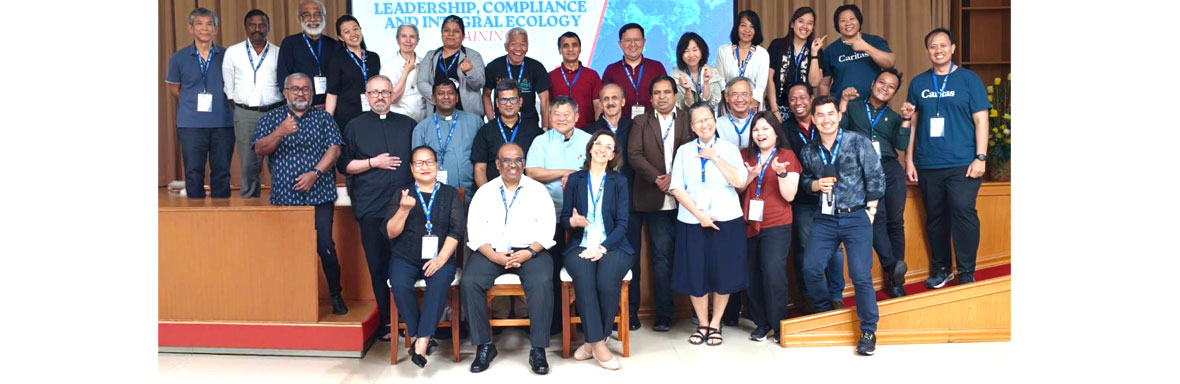
More Than Another Training Programme
At the Camillian Centre in Bangkok, leaders and senior staff of Caritas organizations across Asia gathered not merely for another training programme, but for something deeper: a moment of collective reflection, discernment, and renewed commitment.
Held from April 20 to 23, 2026, the Leadership, Compliance and Integral Ecology training programme came at a significant moment for Caritas Asia as the new Strategic Framework 2026–2030 begins to take shape. Building on previous formation programmes on servant love-based leadership, leadership styles, and safeguarding, this gathering invited participants to pause and ask not only what we are doing, but who we are becoming as Caritas in Asia.
Skilfully facilitated by Mr. Kushal Neogy, the programme created space for honest conversations, critical evaluation, and meaningful exchange among member organizations.
When Safeguarding Becomes a Culture
One of the strongest messages to emerge was that safeguarding cannot remain a matter of policy alone. Through the sharing of experiences by Caritas India and Caritas Indonesia, participants reflected on how safeguarding must become part of the culture and soul of an organization.
Mechanisms and structures are important, but every local context requires wisdom, sensitivity, and adaptation. Leadership, we were reminded, is never about copying models. It is about nurturing environments where dignity, trust, and accountability can flourish.
Beyond Systems, Towards Communion
The discussions led by Ms. Moira Monacelli, Director of the Confederation Development Department at Caritas Internationalis, brought further clarity to the evolving identity of Caritas as a confederation.
Her presentations on the updated Partnership Principles and Modus Operandi and the Caritas Internationalis Management Standards highlighted the importance of professionalism, transparency, accountability, and mutual responsibility within the global Caritas family. These frameworks were presented not merely as institutional requirements, but as pathways toward more authentic and equitable relationships in mission.
Particularly moving was the reflection on the Leadership Charter, described during the programme as both a compass and a mirror. Beyond competence and efficiency, participants emphasized the importance of cultivating a culture of listening, teamwork, continuous learning, and inclusive communication.
Earth Day, Debt, and the Cry of the Poor
The training programme’s reflection on integral ecology, fittingly held on Earth Day, added another important layer. Conversations around climate justice and the “Turn Debt into Hope” campaign highlighted the painful realities faced by vulnerable communities across Asia.
Participants spoke openly about the tensions many churches face in difficult political and social contexts. Yet there was also a shared conviction that silence in the face of suffering can never become the language of the Church.
A Mission That Continues
Bangkok became more than a venue for training. It became a reminder that Caritas is called not simply to manage programmes, but to embody compassion, justice, courage, and hope in a wounded world.
The journey continues across Asia, in our offices, communities, and shared mission to place human dignity and care for our common home at the centre of all we do.
(Fr. Fabian Dicom - Director of Caritas Malaysia)
Beyond Frameworks: A Shared Journey of Leadership and Hope in Asia