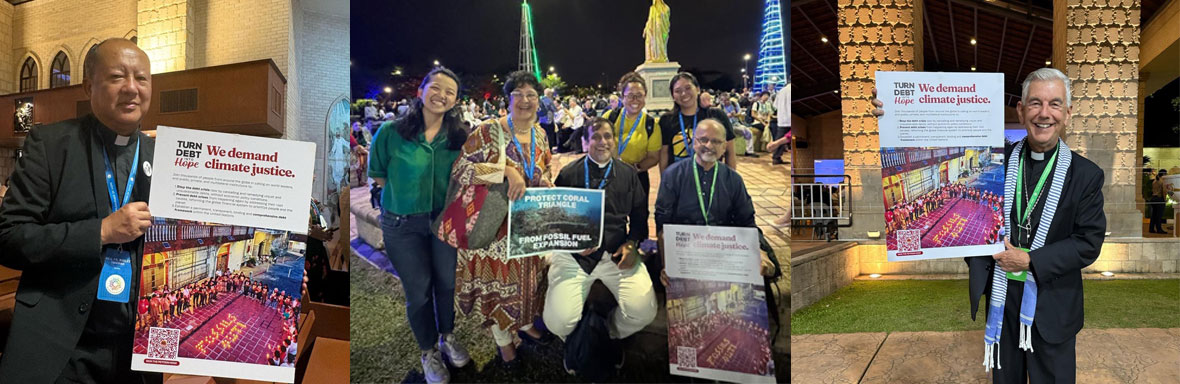
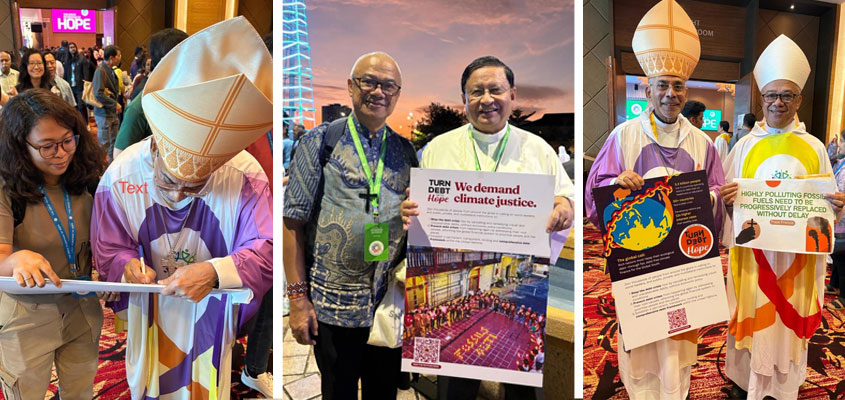
Faith-based organizations across Asia are mobilizing around Turn Debt Into Hope, a global campaign calling for debt cancellation, climate justice, and an end to development models that deepen ecological harm. Anchored in the Jubilee 2025 process, the campaign argues that unsustainable debt and environmental destruction are structurally linked—and that countries most affected by climate change should not be forced to finance their own survival.
Support for the campaign has steadily grown in the region. Caritas organizations from the Philippines, Indonesia, Cambodia, India, Bangladesh, Timor Leste, Taiwan, Malaysia, Thailand, Macau, Kazakhstan, Kyrgyzstan, and CHARIS Singapore have formally signed the petition. Their institutional endorsements are reinforced by individual signatories from the Philippines, Malaysia, Cambodia, and Bangladesh, reflecting grassroots engagement alongside organizational leadership.
The campaign has also drawn backing from prominent environmental advocates. Four Asian recipients of the Goldman Environmental Prize - Batmunkh Luvsandash of Mongolia (2025), Delima Silalahi of Indonesia (2023), Alok Shukla of India (2024), and Fr. Edwin Gariguez of the Philippines (2012) - have endorsed the petition. Philippine Senator Risa Hontiveros is likewise among the signatories, signaling growing political attention to the issue.
Ecclesial support has expanded in parallel. The Catholic Bishops’ Conference of the Philippines, together with priests and bishops from India, Japan, Bhutan, Vietnam, and Thailand have aligned themselves with the campaign’s core demands. At the regional level, the Federation of Asian Bishops’ Conferences (FABC) and its Office for Human Development / Commission on Climate Change and Development (FABC–OHD/CCD) have consistently advanced calls for the recognition of ecological debt and just climate finance.
The theological and pastoral dimensions of the campaign were highlighted during The Great Pilgrimage of Hope Conference: Integral Ecology in Laudato Si’ in Asia, held in Penang, Malaysia, from November 27–30, 2025. In his presentation, Bishop Gerardo A. Alminaza of San Carlos, Philippines, situated debt justice within the broader realities facing Asia: worsening climate impacts, expanding extractive industries, and persistent governance failures that disproportionately affect the poor.
Alminaza emphasized that ecological debt cannot be addressed through technical solutions alone. Drawing on Laudato Si’ and Asian spiritual traditions, he argued that environmental destruction is rooted in moral failure—manifested in corruption, extractivism, and financial systems that externalize ecological costs while indebting vulnerable communities. He underscored the principle of Common But Differentiated Responsibilities (CBDR), calling on historical polluters and wealthy economies to assume greater responsibility for climate finance, loss and damage, and reparative action.
At its core, Turn Debt Into Hope is advancing a clear set of demands: the cancellation of unjust and unsustainable debts, an end to climate loans that deepen dependency, and the redirection of financial systems toward ecological restoration and social protection. For faith-based institutions, the campaign also raises internal questions. It challenges churches in Asia to align advocacy with practice—through fossil-fuel divestment, ethical financing, and the refusal of funding tied to extractive and destructive industries.
As the campaign moves forward, its impact will be measured not only by signatures gathered but by the degree to which Asian churches translate moral positions into institutional reform. In pressing for debt justice, Turn Debt Into Hope is testing whether the Church in Asia can move from solidarity statements to structural accountability—at a time when ecological and economic pressures leave little room for delay.Jing Rey Henderson
Let's #turndebtintohope one signature at a time.
Turning Debt into Hope: Asian Faith Groups Press for Ecological Justice